donderdag 28 juni 2012

A bleak prospect for our children

By Stephanie Pappas, LiveScience Senior Writer


Blueearth
This composite image uses a number of swaths of the Earth's surface taken on January 4, 2012.


Earth is rapidly headed toward a catastrophic breakdown if humans don't get their act together, according to an international group of scientists.
Writing Wednesday (June 6) in the journal Nature, the researchers warn that the world is headed toward a tipping point marked by extinctions and unpredictable changes on a scale not seen since the glaciers retreated 12,000 years ago.
"There is a very high possibility that by the end of the century, the Earth is going to be a very different place," study researcher Anthony Barnosky told LiveScience. Barnosky, a professor of integrative biology from the University of California, Berkeley, joined a group of 17 other scientists to warn that this new planet might not be a pleasant place to live.
"You can envision these state changes as a fast period of adjustment where we get pushed through the eye of the needle," Barnosky said. "As we're going through the eye of the needle, that's when we see political strife, economic strife, war and famine." [Top 10 Ways to Destroy Earth]

The danger of tipping
Barnosky and his colleagues reviewed research on climate change, ecology and Earth's tipping points that break the camel's back, so to speak. At certain thresholds, putting more pressure on the environment leads to a point of no return, Barnosky said. Suddenly, the planet responds in unpredictable ways, triggering major global transitions.
The most recent example of one of these transitions is the end of the last glacial period. Within not much more than 3,000 years, the Earth went from being 30 percent covered in ice to its present, nearly ice-free condition. Most extinctions and ecological changes (goodbye, woolly mammoths) occurred in just 1,600 years. Earth's biodiversity still has not recovered to what it was.
Today, Barnosky said, humans are causing changes even faster than the natural ones that pushed back the glaciers — and the changes are bigger. Driven by a 35 percent increase in atmospheric carbon dioxide since the start of the Industrial Revolution, global temperatures are rising faster than they did back then, Barnosky said. Likewise, humans have completely transformed 43 percent of Earth's land surface for cities and agriculture, compared with the 30 percent land surface transition that occurred at the end of the last glacial period. Meanwhile, the human population has exploded, putting ever more pressure on existing resources. [7 Billion Population Milestones]
"Every change we look at that we have accomplished in the past couple of centuries is actually more than what preceded one of these major state changes in the past," Barnosky said.

Backing away from the edge
The results are difficult to predict, because tipping points, by their definition, take the planet into uncharted territory. Based on past transitions, Barnosky and his colleagues predict a major loss of species (during the end of the last glacial period, half of the large-bodied mammal species in the world disappeared), as well as changes in the makeup of species in various communities on the local level. Meanwhile, humans may well be knotting our own noose as we burn through Earth's resources.
"These ecological systems actually give us our life support, our crops, our fisheries, clean water," Barnosky said. As resources shift from one nation to another, political instability can easily follow.
Pulling back from the edge will require international cooperation, Barnosky said. Under business-as-usual conditions, humankind will be using 50 percent of the land surface on the planet by 2025. It seems unavoidable that the human population will reach 9 billion by 2050, so we'll have to become more efficient to sustain ourselves, he said. That means more efficient energy use and energy production, a greater focus on renewable resources, and a need to save species and habitat today for future generations.
"My bottom line is that I want the world in 50 to 100 years to be at least as good as it is now for my children and their children, and I think most people would say the same," Barnosky said. "We're at a crossroads where if we choose to do nothing we really do face these tipping points and a less-good future for our immediate descendents."
http://www.huffingtonpost.com/2012/06/07/earth-tipping-point-study_n_1577835.html


Unfortunately the Rio+20 conference once more ended with hollow promises and no firm actions. To keep within the 2° C mean temperature rise (which is too much according to many!) it is known how much total CO² emissions until 2050 is "allowed"... and that amount will be all used-up by 2023. :-(

You might consider it the greatest and most infamous of all Ponzi Schemes!

-----------
Let *me* add a very grim tale of population growth and -collapse; all the way to extinction!

During World War II, while trying to stock a remote island in the Bering Sea with an emergency food source, the U.S. Coast Guard set in motion a classic experiment in the boom and bust of a wildlife population.
The island was St. Matthew, an unoccupied 32-mile long, four-mile wide sliver of tundra and cliffs in the Bering Sea, more than 200 miles from the nearest Alaska village. In 1944, the Coast Guard installed a loran (long range aids to navigation) station on St. Matthew to help captains of U.S. ships and aircraft pilots pinpoint their locations. The Coast Guard stationed 19 men on St. Matthew Island to operate the station. Those men—electrical technicians, cooks, medics, and others—made up the entire human population of the island.
In August 1944, the Coast Guard released 29 reindeer on the island as a backup food source for the men. Barged over from Nunivak Island, the animals landed in an ungulate paradise: lichen mats four inches thick carpeted areas of the island, and the men of the Coast Guard station were the reindeer’s only potential predators.
The men left before they had the chance to shoot a reindeer. With the end of World War II approaching, the Coast Guard pulled the men from the island. St. Matthew’s remaining residents were the seabirds that nest on its cliffs, McKay’s snow buntings and other ground-nesting birds, arctic foxes, a single species of vole, and 29 reindeer.
St. Matthew then had the classic ingredients for a population explosion—a group of healthy large herbivores with a limited food supply and no creature above them in the food chain. That’s what Dave Klein saw when he visited the island in 1957.
Klein was then a biologist working for U.S. Fish and Wildlife Service. He is now a professor emeritus with the University of Alaska Fairbanks’ Institute of Arctic Biology. The first time he hiked the length of St. Matthew Island in 1957, he and field assistant Jim Whisenhant counted 1,350 reindeer, most of which were fat and in excellent shape. Klein noticed that reindeer had trampled and overgrazed some lichen mats, foreshadowing a disaster to come.
Klein did not get a chance to return to the island until the summer of 1963, when a Coast Guard cutter dropped him and three other scientists off on the island. As their boots hit the shore, they saw reindeer tracks, reindeer droppings, bent-over willows, and reindeer after reindeer.
“We counted 6,000 of them,” Klein said. “They were really hammering the lichens.”
The herd was then at a staggering density of 47 reindeer per square mile. Klein noted the animals’ body size decreased since his last visit, as had the ratio of yearling reindeer to adults. All signs pointed to a crash ahead.
Other work commitments and the difficulty of finding a ride to St. Matthew kept Klein from returning until the summer of 1966, but he heard a startling report from men on a Coast Guard cutter who had gone ashore to hunt reindeer in August 1965—the men had seen dozens of bleached reindeer skeletons scattered over the tundra.
When Klein returned in the summer of 1966, he, another biologist and a botanist found the island covered with skeletons; they counted only 42 live reindeer, no fawns, 41 females and one male with abnormal antlers that probably wasn’t able to reproduce. During a few months, the reindeer population of St. Matthew had dropped by 99 percent.
By piecing together clues found amid the bones, Klein figured that thousands of reindeer starved during the winter following his last visit, when he counted 6,000 animals on the island. Weather records from St. Paul and Nunivak islands for the winter of 1963-1964 showed an extreme winter in both cold and amount of snowfall.
With no breeding population, the reindeer of St. Matthew Island died off by the 1980s. The unintended experiment in population dynamics and range ecology ended as it began—with winds howling over the green hills of a remote island in the Bering Sea, a place where arctic foxes are once again the largest mammals roaming the tundra.
http://www2.gi.alaska.edu/ScienceForum/ASF16/1672.html

zaterdag 5 mei 2012

Zonnestroom week

Na lang denken, vergelijken en informatie inwinnen heb ik uiteindelijk voor de kwaliteit van Canadian Solar panelen gekozen. Begin maart had ik ze besteld, maar omdat er net een grote bestelling was uitgeleverd duurde het iets langer dan normaal, alvorens geleverd werd...

... misschien dat ik daarom 240 Wp panelen kreeg ipv de 230 Wp die ik bestelde en betaalde; ik had al 'n paar keer gebeld... 

De FlatFix montage set is ideaal; daar hoef je niet eens echt bij na te denken! Ik koos voor FlatFix omdat ik het gewicht op m'n platte dak zo laag mogelijk moet houden en een opstelling met slechts 20° helling geen rendementsverlies oplevert. En doordat de panelen iets minder hoog boven het dak uitsteken heb je wat minder tussenruimte nodig om in de winter schaduw op panelen te voorkomen.
In mijn geval heb ik ook nog eens multiplex platen onder de FlatFix gelegd om het gewicht over een groter oppervlak te verdelen.


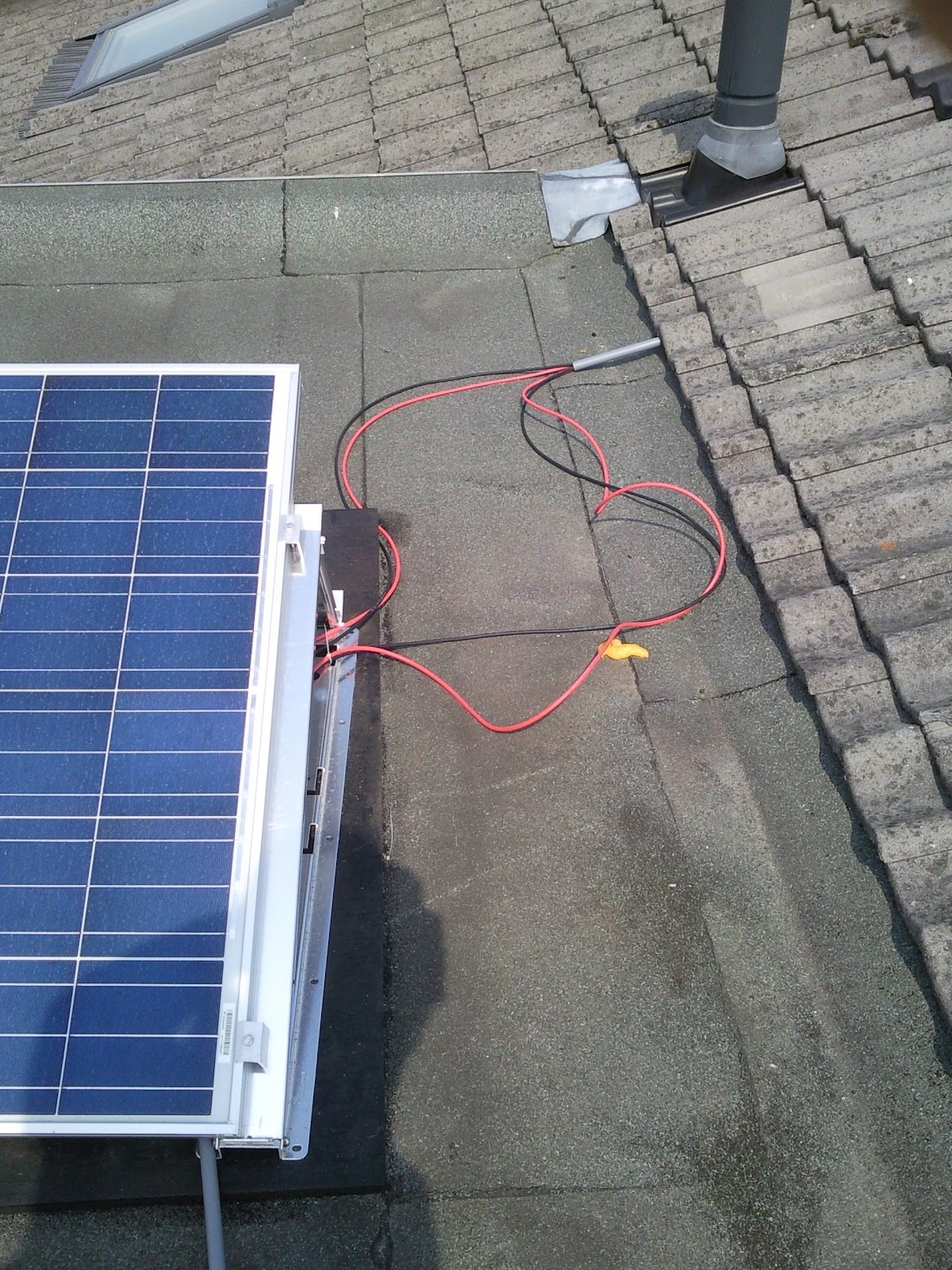
Ik heb één voor een de FlatFix profielen opengeklapt en met RVS boutjes in elkaar gezet. De maatvoering voor de panelen deed ik bij benadering. De hoekprofielen aan de achterkant klikken op hun plaats maar kunnen een beetje schuiven: bij het plaatsen van de Canadian Solar panelen heb ik dat gebruikt door éérst een uiteinde te prepareren( boutjes erin gedraaid). Daarna paneel op de plaats leggen en boutjes die *tussen* de twee panelen moeten komen plaatsen. Nu kun je het FlatFix profiel heel makkelijk en "op de milimeter nauwkeurig" aanschuiven tot alles op maat is... en zo verder. Makkie!

Bij het aansluiten van de kabels en het plannen van de dakdoorvoer is goed nadenken belangrijk, maar een handige DHZ'er klaart dat klusje wel. Vergeet niet dat bij meerdere strings de 4 mm² elektrische bedrading niet door één standaard 5/8 pijpje past! 3/4 pijp, bij voorkeur slagvast (Hostaliet), lukt wèl.


De Soladin 600 inverter; deze moet binnen, liefst niet te ver van de panelen weg geplaatst worden maar belangrijk is te bedenken dat de inverter (bij vol vermogen; koeling) geluid maakt! Sommigen zullen het bij volle zon als hinderlijk ervaren (er zit een hoge frequentie bij..) en dus is de keuze voor een plaatsje iets om serieus over na te denken! Een pluspuntje van de Soladin 600 vind ik dat deze - als de drempel van stroomproductie niet gehaald wordt - zichzelf compleet uitschakelt, waardoor alle geluid verstomt en er geen stroom door de inverter (nodeloos) gebruikt wordt! Een tweede pluspunt en zo mogelijk nog belangrijker is zeker de eenvoud van installatie: de string panelen aansluiten, stekker in een 230V stopcontact en klaar is Klara! Ideaal!


Een datakabeltje voor uitlezen van de Soladin 600 is niet essentieel maar gewoon wel een leuk hebbedingetje en de Soladin software - bij de Mastervolt website gratis te downloaden - geeft dan duidelijk overzicht van alle belangrijke parameters waaronder totaal aantal "draaiuren" en totale stroomproductie


Na een paar dagen zon en een paar dagen wolken heeft de installatie binnen één week al 35 kWh opgeleverd. De oplettende lezer denkt dan; hoe kan dat met een 690 (in mijn geval dus werkelijk 720 Wp) installatie?

Simpel: ik had meteen twee setjes besteld en geplaatst! In theorie had ik hetzelfde aantal panelen via 1 converter aan kunnen sluiten maar ik heb wel eens gehoord dat de converter (soms) eerder vervangen moet worden als de panelen en dan ligt m'n hele installatie tijdelijk stil. Ook is dan zelfs een klein beetje schaduw van invloed op de string van 6 panelen, nu bij mij is dat dus per string van 3 panelen.


Over die schaduw: in de morgen valt er tijdelijk schaduw van het pijpje van de mechanische ventilatie van de buren op het hoekje van één paneel. Omdat het knipperen van de LEDs op de Soladin een goede aanwijzing geven voor de productie viel dat meteen op: de ene string produceerde ineens ruwweg twee keer zoveel als de andere, die op een miniem hoekje schaduw kreeg!

Als u ook - net als ik - twee setjes (of meer?) wilt aansluiten moet u dat over meerdere elektra groepen verdelen, of als u heel erg handig bent zou u één aparte groep ervoor kunnen aanleggen (of de rest van een bestaande groep buiten gebruik stellen!).

Als u zich niet thuis voelt met tang en schroevendraaiers in uw groepenkast zou u er zonder meer voor moeten kiezen om de installatie aan te LATEN leggen! Maar alles wat "achter de meter en hoofdzekering(en) zit" is van u en eraan werken is - strikt genomen - toegestaan.... of het wenselijk en verantwoord is, is een vraag die u zichzelf moet stellen.

Met deze (DHZ) set heeft u ècht geen excuus meer om geen zonnepanelen te installeren.

dinsdag 6 september 2011

European Wilderness; Certified PAN Parks

Een aantal - op het moment dat ik dit schrijf 11 stuks - van de grootste en meest bijzondere natuurgebieden in Europa hebben zich verenigd onder een koepelorganisatie: PAN Parks.

Zweden, Finland, Rusland, Portugal hebben parken in Europa. Verder zijn er PAN parken in Estland, Roemenië, Bulgarije, Georgië en Italië.

Correct: de dichtstbijzijnde gebieden zijn zo'n 2000 KM verderop, in heel West Europa... niets?
http://www.panparks.org/learn/certified-pan-parks

Laat ik eens mijn nek uitsteken: één van de belangrijke criteria is een natuurgebied van minimaal 20,000 HA.

De provincie Flevoland heeft: Oostvaardersplassen, samen met de Lepelaars plassen al zo'n 6,000 HA zéér vermaard natuurgebied; wetlands met grote natuurwaarde voor vogels, maar ook de grootste kudde wilde Konik paarden in Europa! En aan de andere kant van de Oostvaardersdijk ligt het Natura 2000 Markermeer / IJmeer gebied; maar liefst 68,500 HA groot!

In potentie hebben we daarmee prachtige troeven in handen om een PAN Park van de grond te trekken! Een korte rondgang door de lijst met te vervullen criteria op gebied van (wettelijke) inbedding en bescherming stemt me hoopvol en de doelstellingen (onder meer ECOtoerisme en alleen duurzame ontwikkelingen toestaan) passen goed bij Flevolands Imago. En... als toeristische trekpleister niet te versmaden: het Italiaanse park trekt bijvoorbeeld ruim 'n half miljoen bezoekers.

Het is (nu nog?) een droom... een héél ambitieuze droom: mag ik? :-)


http://www.panparks.org/learn/case-studies/example-cases

Wilderness species

Re-introduction of wilderness species is high on the agenda of PAN Parks. Successful projects include: re-introduction of Apennine chamois in Majella NP, Italy, and the re-introduction of Griffon Vultures in Central Balkan NP, Bulgaria.

Iconic species

Photo: iStock/BostjanT 
 Important wilderness indicative species in the PAN Parks network are the brown bear, wolves and the lynx. These species can be found in Fulufjället NP, Sweden, Rila NP and Central Balkan NP, Bulgaria.
Another important wilderness indicative species is the golden eagle in Retezat NP, Romania or the sea eagle in Archipelago NP, Finland.
Important wilderness indicative species in Oulanka NP, Finland is the orchid - Calypso Bulbosa.

Feral species

In Peneda-Geres NP, Portugal feral horses Equus caballus live in the PAN Parks Wilderness. These horses are not managed at all and represent an exceptional case of wild horses on the Iberian Peninsula and possibly the only wild horses in Europe.

maandag 11 juli 2011

'Four degrees and beyond': on the threshold...


"Don't blow it... good planets are hard to find!"


De wereldwijde CO² en andere broeikas gassen uitstoot en herkomst (en de link waar ik 'm vond)


There is now little to no chance of maintaining the rise in global mean surface temperature at below 2°C, despite repeated high-level statements to the contrary. Moreover, the impacts associated with 2°C have been revised upwards (e.g. [20,21]), sufficiently so that 2°C now more appropriately represents the threshold between dangerous and extremely dangerous climate change. http://rsta.royalsocietypublishing.org/content/369/1934/20.full

... model projections from the IPCC, (our) best estimate is that the A1FI emissions scenario would lead to a warming of 4°C relative to pre-industrial during the 2070s. If carbon-cycle feedbacks are stronger, which appears less likely but still credible, then 4°C warming could be reached by the early 2060s in projections that are consistent with the IPCC’s ‘likely range’.  http://rsta.royalsocietypublishing.org/content/369/1934/67.full

The big picture and potential ramifications is painted at : http://rsta.royalsocietypublishing.org/content/369/1934.toc (a few of the abstracts cannot be freely accessed here; google the title and get the PDF's elsewhere free)

A "comforting" thought: the "same" people that brought us here and gave us NUCLEAR POWER plants are now planning (experimenting?) GEO-ENGINEERING! Think we should trust them, again?

What's next: we push earth into a wider orbit around the sun? :-(

vrijdag 8 juli 2011

"The Ostrich Generation": Global Warming and a bottom-up approach.

When planning for a year, plant corn. When planning for a decade, plant trees. When planning for life, educate people - Chinese Proverbs"

Even while most of us largely ignore the Global Warming Issues we face, time to act is running out, fast! Science on cause(s) and effect(s) is divided: roughly 2% of all scientists disagree – based on unscientific arguments, research done by oil-companies etc – with the 98% of the scientific community worldwide, who are trying to tell us we *do* have a serious problem.

The longer we wait & ignore this matter, the more serious it will become… somewhat like a malignant tumour. Ignore that for any length of time and you pay for that mistake the ultimate price! Yet we are bombarded with a daily deluge of adverts prodding us to consume *more*, not less! Sooner or later things will be turned around, if not by us, then by nature’s wrath.

Are we really so egotistical that we can accept our children or grandchildren will face a catastrophic collapse of world economy, and world population? Think of the Mayan culture… on a worldwide scale.

Expecting your government to come out & tell you (order you, if we wait much longer) that we have to take back a few steps is hardly realistic: we do not act of our own accord, so politicians bringing you that message will not have long, distinguished careers. So they meet in lovely places like Cancun, Kyoto, Copenhagen and utter hollow phrases and call them accords. And things remain as they were before; like Lemmings we are running towards the cliff, towards a mass extinction.

To keep this consumerism going and staying in “power” (for what that’s worth) politicians will lie and cheat, build Nuclear Power stations, look the other way when risks & defects are found. They will happily tell you there is an abundance of oil to be found just to the north of the US border, in the Canadian Tar Sands. They will *not* tell you of the ecological impact oil production from Tar Sands will have!

Someone remarked: “how can we tell the Brazilian People not to slash & burn their Amazonian Rain Forrest if we start oil production from the Tar Sands?” How very true! And it was a catalyst for a train of thoughts, none really spectacular or earth shattering, on one change that might help turning around our behaviour just a little bit.

We have to make the children aware of the problems we face, and it should be in the school curriculum, just like geography and history are today! In 10, 15 years time there will be a major change in people’s behaviour, not merely the kid’s behaviour but – faced by tough questions – also in us, the “ostrich generation”.

That this approach can, nay will work was maybe best illustrated by none other than the big oil and coal lobby in the USA: until the spring of 2011 they funded a curriculum in schools in a number of states in the USA, promoting the use of coal and oil.. until it became public knowledge! If they put millions into it you can safely bet it must have been worth their while... and d*mn effective! :-(

dinsdag 28 juni 2011

Twee SECONDEN voor TWAALF

Even heel kort wat weetjes op een rij gezet:

 De situatie = nu...  ± 390 ppm broeikasgassen, Jaarlijks komt daar zo'n 2 ppm bij.
"beperken" tot ± 450 ppm zal NIET meer gehaald worden. Vergeet alle "prachtige" akkoorden over beperken temperatuurstijging tot 2° C... loze woorden, daden ontbreken overal, de WIL al helemaal.

Het gevolg / vervolg:

Quote: Last time mean global temperatures reached 2 to 3 degrees Celsius above present levels, in the mid-Pliocene (3 million years ago), an event associated with CO2 levels of about 400 parts per million, polar regions were heated by near 8 degrees C ** and sea levels have risen by 25+/-12 meters relative to the present. This represents near-total melting of Greenland and west Antarctica ice sheets (Robinson et al., 2008: “Pliocene role in assessing future climate impacts” (http://pubs.giss.nasa.gov/abstracts/2008/Robinson_etal.html).
 ** Inmiddels is vasgesteld dat de 8° C in de poolstreken al zo'n beetje gehaald is!

Indien langere tijd broeikasgassen boven de 450 ppm uitkomen en blijven:

A rise of mean global temperatures above 4 or 5 degrees Celsius would shift the atmosphere to pre-glacial/interglacial conditions, which dominated the Earth from about 34 million years ago (end-Eocene) (Zachos et al., 2008) http://www.nature.com/nature/journal/v451/n7176/full/nature06588.html

That means an ultimate sea level rise of 250 feet, with the best current projection being 5 feet by 2100 (see “Startling new sea level rise research: “Most likely” 0.8 to 2.0 meters by 2100“), rising thereafter 10 to 20 inches a decade (or more) for centuries. Good luck adapting to that, next 50 generations.

Volgens onderzoekers kan de 4° C temperatuurstijging tussen 2070 en 2080 "gehaald" zijn, mogelijk al rond 2060! 

(Dat zijn dus historische cijfers, geen loze prognoses!) Op onze huidige koers gaan we naar + 1000 ppm en dat is volstrekt onomkeerbaar!

Nederland verdedigen tegen 10 meter zeespiegelstijging of meer of 5 tot 10 cm stijging per JAAR is onmogelijk... dan zal het heel druk worden in de Belgische Ardennen en het Duitse Sauerland! En in de rest van de wereld zal het niet anders gaan.

P.S. Het volledige engelstalige artikel vind u hier:
http://thinkprogress.org/romm/2009/03/17/203822/media-copenhagen-global-warming-impacts-worst-case-ipcc/

Een andere bron van verontrustende gegevens; de IEA!!:
http://www.nytimes.com/cwire/2011/01/24/24climatewire-scenario-to-cap-world-emissions-by-2020-is-f-69072.html

vrijdag 17 juni 2011

Brede- of Rietorchis


Op 9 juni in Landstrekenwijk aangetroffen en met Samsung Jet gefotografeerd :-)